
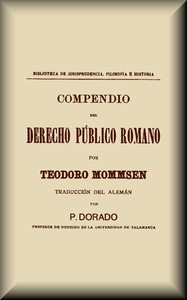
Compendio del derecho público romano by Theodor Mommsen
Let's be clear from the start: this is not a beach read. Theodor Mommsen's Compendio del derecho público romano is a focused, scholarly look at the public law of ancient Rome. But don't let that scare you off. Think of it as the ultimate guide to the rules of the game—the constitution, the government structure, the legal principles that held the Roman state together.
The Story
There isn't a plot in the traditional sense. Instead, Mommsen systematically walks you through the architecture of Roman public life. He starts with the foundational ideas of sovereignty and citizenship. Who had power, and where did it come from? He then maps out the entire government: the assemblies where citizens voted, the Senate that advised, and the magistrates who executed the laws. He explains how offices worked, how provinces were administered, and how the military fit into the legal framework. The book shows how this system evolved, from the early Republic all the way through the Imperial period, highlighting the changes and continuities that kept the empire running.
Why You Should Read It
This book connects dots. You might know about Julius Caesar or Augustus, but Mommsen shows you the stage they were performing on. Understanding the cursus honorum (the sequence of public offices) makes the ambitions of politicians like Cicero make more sense. Seeing how provincial governance was set up helps explain both Rome's success and its eventual strains. Mommsen isn't just listing dry statutes; he's revealing the logic of a civilization. His insight is that Rome's greatness wasn't just military might—it was a unique and adaptable legal and administrative genius. Reading this feels like being handed a master key to a thousand other history books.
Final Verdict
This is a specialist's book, but its value for an engaged reader is huge. It's perfect for history buffs, law students, or anyone fascinated by political systems who already has a basic grounding in Roman history. It's the book you read after you've enjoyed the popular narratives of battles and emperors, when you start asking, 'But how did it actually work day-to-day?' Approach it not as a story to be raced through, but as a reference and a revelation. Take it chapter by chapter, and you'll gain a profound appreciation for the machinery behind the marble monuments.
This masterpiece is free from copyright limitations. Use this text in your own projects freely.
Matthew Anderson
11 months agoAfter finishing this book, the storytelling feels authentic and emotionally grounded. Don't hesitate to start reading.
William Perez
1 year agoA bit long but worth it.
Emily Harris
1 year agoHaving read this twice, the flow of the text seems very fluid. Worth every second.
Dorothy White
2 years agoA bit long but worth it.





Sandra Jackson
1 year agoI started reading out of curiosity and the author's voice is distinct and makes complex topics easy to digest. Exactly what I needed.