
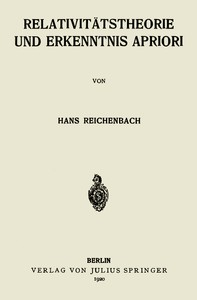
Relativitätstheorie und Erkenntnis Apriori by Hans Reichenbach
This isn't a story with characters and a plot in the usual sense. The 'story' here is the dramatic collision of two giant ideas in the early 20th century. The first is Immanuel Kant's philosophy of 'a priori' knowledge—the belief that certain fundamental truths (like the rules of geometry or cause-and-effect) are hardwired into human reason and are true no matter what we observe. They're the unchanging stage upon which the play of science happens.
The Story
Then enters the second character: Albert Einstein's theory of relativity. Einstein didn't just add new facts; he showed that the very stage Kant thought was fixed—absolute space and time—was actually flexible and relative. Reichenbach, a philosopher-scientist who worked with Einstein, acts as the narrator of this collision. He walks us through how relativity forces us to rewrite the script. Concepts we thought were pure 'a priori' truths, like Euclidean geometry, turn out to be choices we make to best describe the physical world. The 'story' is the thrilling unraveling of old certainties and the careful construction of a new relationship between what we think we know and what we discover.
Why You Should Read It
You should read this because it makes philosophy urgent. It's not abstract pondering; it's a live report from the front lines of a conceptual revolution. Reichenbach writes with the excitement of someone who helped make the mess and is now figuring out how to clean it up. His clarity is a gift. He takes the brain-melting implications of relativity and connects them directly to the big questions: What can we really know for sure? How much of our reality is built by our minds? Reading it, you feel your own assumptions being gently pried apart and examined. It’s intellectually bracing.
Final Verdict
This book is perfect for curious readers who enjoyed books like 'Gödel, Escher, Bach' or 'A Brief History of Time,' but are ready for a deeper, more philosophical dive. It's for the person who loves the history of ideas and wants to witness the precise moment modern philosophy of science was born. It's challenging, no doubt—you'll need to go slow—but the payoff is a clearer, more sophisticated understanding of how science and human thought actually work together. Skip it if you want a simple pop-science explainer. Embrace it if you want to feel the ground shift under your feet.
This digital edition is based on a public domain text. It is now common property for all to enjoy.
Deborah Anderson
1 year agoThis book was worth my time since the content flows smoothly from one chapter to the next. I would gladly recommend this title.
Thomas Walker
10 months agoAfter finishing this book, the storytelling feels authentic and emotionally grounded. Worth every second.




Richard White
7 months agoText is crisp, making it easy to focus.